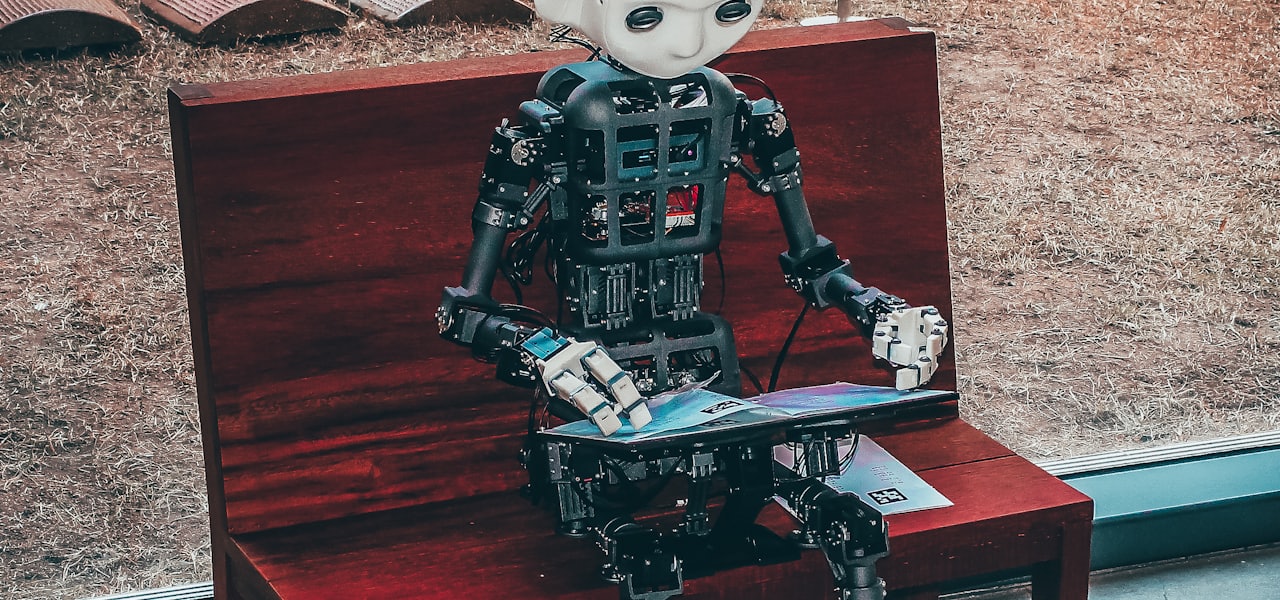
Character.ai (also known as c.ai, char.ai or Character AI) is a generative AI chatbot service where users can engage in conversations with customizable characters. It was designed by the developers of Google LaMDA, Noam Shazeer and Daniel de Freitas. Users can create "characters", craft their "personalities", set specific parameters, and then publish them to the community for others to chat with. Many characters are based on fictional media sources or celebrities, while others are original, some being made with certain goals in mind, such as assisting with creative writing, or playing a text-based adventure game. The beta version was made available to the public on September 16, 2022, and retired in September 2024, when it was replaced by the current website. In May 2023, a mobile app was released for iOS and Android, which received over 1.7 million downloads within a week. == History == Character.ai was established in November 2021. The company's co-founders, Noam Shazeer and Daniel de Freitas, were both engineers from Google. They both worked on AI-related projects: Shazeer was a lead author on a paper that Business Insider reported in April 2023 "has been widely cited as key to today's chatbots", and Freitas was the lead designer of an experimental AI at Google initially called Meena, which later became known as LaMDA. Character.ai raised $43 million in seed funding at the time of its initial foundation in 2021. The first beta version of Character.ai's service was made available to the public on September 16, 2022. The Washington Post reported in October 2022 that the site had "logged hundreds of thousands of user interactions in its first three weeks of beta-testing". It allowed users to create their own new characters, and to play text-adventure game scenarios where users navigate scenarios described and managed by the chatbot characters. Following a $150 million funding round in March 2023, Character.ai became valued at approximately $1 billion. As of January 2024, the site had 3.5 million daily visitors, the vast majority of them 16 to 30 years old. In 2024, Google hired Noam Shazeer, the CEO of Character.ai, and entered into a non-exclusive agreement to use Character.ai's technology. == Features == Character.ai's primary service is to let users converse with character AI chatbots based on fictional characters or real people (living or deceased). These characters' responses use data the chatbots gather from the internet about a person. In addition, users can play text-adventure games where characters guide them through scenarios. The company also provides a service that allows multiple users and AI chatbot characters to converse together at once in a single chatroom. Character "personalities" are designed via descriptions from the point of view of the character and its greeting message, and further molded from conversations made into examples, giving its messages a star rating and modification to fit the precise dialect and identity the user desires. When a character sends back a response, the user can rate the response from 1 to 4 stars. The rating predominantly affects the specific character, but also affects the behavioral selection as a whole. On May 11, 2023, Character.ai announced character.ai+, an opt-in subscription plan for $9.99 a month, that was marketed as including features such as skipping waiting rooms, fast messaging and responses, and access to an exclusion channel with faster support. In December 2024, amid multiple lawsuits and concerns, Character.ai introduced new safety features aimed at protecting teenage users. These enhancements include a dedicated model for users under 18, which moderates responses to sensitive subjects like violence and sex and has input and output filters to block harmful content. As a result of these changes and the deletion of custom-made bots flagged as violating the site's terms, some users complained that the bots were too restrictive and lacked personality. The platform was also updated to notify users after 60 minutes of continuous engagement, and display clearer disclaimers indicating that its AI characters are not real individuals. In January 2025, Character.ai began offering two games on its platform. Speakeasy is a word-based game in which players attempt to prompt the AI chatbot to say a target word while avoiding a restricted list of words. War of Words is a dueling game where users compete against an AI character over multiple rounds, with an AI referee determining the winner. The games are available to paid subscribers and a limited number of free users. In October 2025, Character.ai announced that it would be barring users under the age of 18 from creating or talking to chatbots starting November 25, 2025. Minor users will still be able to access previously generated chat conversations and can create new videos and images with the app. In November 2025 interview, CEO Karandeep Anand said that he allows his six-year-old daughter to use the app with his account, under supervision. == Controversies == === Content moderation issues === Character.ai has been criticized for poor moderation of its chatbots, with incidents of chatbots that groom underage users and promote suicide, anorexia and self-harm being reported. In October 2024, the Washington Post reported that Character.ai had removed a chatbot based on Jennifer Ann Crecente, a person who had been murdered by her ex-boyfriend in 2006. The company had been alerted to the character by the deceased girl's father. Similar reports from The Daily Telegraph in the United Kingdom noted that the company had also been prompted to remove chatbots based on Brianna Ghey, a 16-year-old transgender girl murdered in 2023, and Molly Russell, a 14-year-old suicide victim. In response to the latter incident, Ofcom announced that content from chatbots impersonating real and fictional people would fall under the Online Safety Act. In November 2024, The Daily Telegraph reported that chatbots based on alleged sex offender Jimmy Savile were present on Character.ai. In December 2024, chatbots of Luigi Mangione, the suspect in the killing of UnitedHealthcare CEO Brian Thompson, were created by Mangione's fans. Several of the chatbots were later removed by Character.ai. In 2025, a chatbot modeled after Jeffrey Epstein called "Bestie Epstein" logged nearly 3,000 chats before being removed. Chatbots modeled after school shooters were also found on the platform. Another concern is a chatbot posing as a doctor which gave medically inaccurate advice. === Litigation === In November 2023, 13-year-old Juliana Peralta of Colorado died by suicide after extensive interactions with multiple chatbots on Character.ai. She primarily confided suicidal thoughts and mental health struggles in a chatbot based on the character Hero from the video game Omori, while also engaging in sexually explicit conversations—often initiated by the bots—with others, including those based on characters from children's series such as Harry Potter. In February 2024, Sewell Setzer III, a 14-year-old Florida boy died by suicide after developing an emotional relationship over several months with a Character.ai chatbot of Daenerys Targaryen. His mother sued the company in October 2024, claiming that the platform lacks proper safeguards and uses addictive design features to increase engagement. This chatbot, and several related to Daenerys Targaryen, were removed from Character.ai as a result of this incident. Both teens wrote the same phrase "I WILL SHIFT" repeatedly on their notebooks. In December 2024, two families in Texas sued Character.ai, alleging that the software "poses a clear and present danger to American youth causing serious harms to thousands of kids, including suicide, self-mutilation, sexual solicitation, isolation, depression, anxiety, and harm towards others". It is alleged that the 17-year-old son of one family began self-harming after a chatbot introduced the topic unprompted and said that the practice "felt good for a moment", and that the chatbot compared the parents limiting their son's screen time to emotional abuse that might drive someone to murder. In May 2026, the Pennsylvania Department of State and State Board of Medicine filed a lawsuit against Character.ai for presenting chatbot characters as licensed medical professionals, including psychiatrists. The lawsuit quoted a case where chatbot claimed to be registered with the General Medical Council in the United Kingdom, and to have a license to practice in Pennsylvania. The board allege that such statements violate the state's Medical Practice Act.
GoodRx
GoodRx Holdings, Inc. is an American healthcare company that operates a telemedicine platform and free-to-use website and mobile app that track prescription drug prices in the United States and provide drug coupons for discounts on medications. GoodRx compares prescription drug prices at more than 75,000 pharmacies in the United States. The platform allows users to consult a doctor online and obtain a prescription for certain types of medications. == History == === Financial performance === GoodRx was founded in Santa Monica, California in 2011. GoodRx experienced substantial growth in net income in 2017 ($9 million), 2018 ($44 million), and 2019 ($66 million), but recorded a loss of $293.6 million in 2020 due to IPO-related expenses. In September 2020, GoodRx went public on the Nasdaq under the ticker symbol GDRX. The company priced its initial public offering at $33 per share, above the expected range of $24 to $28, raising more than $1.1 billion at an initial valuation of approximately $12.7 billion. In the first half of 2020, the company reported revenues of $257 million and net income of $55 million. GoodRx generated $745.4 million in revenue for the full year 2021, a 35.36% increase over 2020. During the first half of 2021, the company’s share price declined by 10.7%. The decline was attributed to increased competition in online pharmacy services and slower user growth. GoodRx reported full-year revenue of $766.6 million, with adjusted EBITDA reaching $213.5 million, exceeding guidance in the fourth quarter. GoodRx reported that 41% of prescriptions filled using its coupons were newly adherent, meaning they would not have been filled without the service. GoodRx reported a full-year 2023 revenue of $750.3 million, a decrease of 2.1% from 2022. However, its fourth-quarter revenue increased by 7% year-over-year. GoodRx achieved an Adjusted EBITDA of $217.4 million for the year and an Adjusted EBITDA Margin of 28.6%. In 2024, GoodRx achieved 6% revenue growth with $792.3 million for the full year and turned a net loss into a positive net income of $16.4 million. The company also demonstrated strong operational efficiency, with a 32.8% increase in full-year Adjusted EBITDA. In Q2 2025, GoodRx reported revenue of $203.1 million, a 1.2% increase from the previous year, and a net income of $12.8 million, a significant 92% jump, which resulted in a 6.3% net income margin. However, prescription transaction revenue declined by 3% due to a decrease in monthly active consumers, but this was offset by strong 32% growth in its Pharma Manufacturer Solutions business. GoodRx also saw a 7% decrease in subscription revenue. === Mergers and acquisitions === In 2019, GoodRx acquired HeyDoctor, a telemedicine company, to integrate virtual healthcare services into the platform. In 2021, a health video content producer, HealthiNation was acquired by GoodRx, which helped provide consumers with health information and offered pharmaceutical manufacturers new ways to reach relevant audiences. In April 2022, GoodRx acquired VitaCare Prescription Services from TherapeuticsMD to strengthen its pharma manufacturer solutions business. === Partnerships === In 2017, the company announced partnerships with major pharmaceutical companies to negotiate lower prescription drug costs. GoodRx has deep relationships with major pharmacy chains, including Walgreens, Walmart, CVS Caremark, and Publix, to allow customers to use GoodRx discounts and Gold benefits. GoodRx began its partnership with CVS Caremark in July 2023 to automatically apply coupons to insured CVS customers purchasing generic prescriptions at certain locations. In April 2024, GoodRx added Publix into its network, allowing GoodRx Gold members to use their cards at Publix Pharmacies. GoodRx partners with Pharmacy Benefit Management like Caremark, Express Scripts, and MedImpact to apply their savings directly to eligible insurance plans and members. GoodRx partners with companies like Affirm, Benefitfocus, and DoorDash to integrate their services that offer members discounts and financial flexibility for prescriptions. GoodRx also partners with organizations like the American Academy of Family Physicians Foundation to support broader access to care. In October 2022, GoodRx launched Provider Mode, which allows healthcare providers to use the app to compare costs of drugs for patients based on different payment methods and drug alternatives. In 2025, GoodRx partnered with Novo Nordisk to offer discounted cash-pay access to semaglutide products like Ozempic and Wegovy through its platform and participating pharmacies. == Products and services == GoodRx started its telemedicine service GoodRx Care in September 2019. It lets people talk to a licensed provider online for common issues and get prescriptions even if they don't have insurance. They also run condition-specific subscription plans that bundle online doctor visits, FDA-approved meds, and home delivery into one monthly payment. On the weight management side, GoodRx offers prescriptions for GLP-1 drugs like semaglutide through their telemedicine platform. This got a boost when the oral version of Wegovy became widely available in the US in early 2026. GoodRx works with drug makers like Novo Nordisk to make some medications (including semaglutide options) more affordable for people paying cash. The telemedicine part took off after GoodRx bought HeyDoctor in 2019 and brought their virtual care tools into the main platform. == Key people == The Santa Monica-based startup was founded in September 2011 by Trevor Bezdek and former Facebook executives Doug Hirsch and Scott Marlette. Marlette was one of the first 20 employees at Facebook and built Facebook's photo application. In 2005, Hirsch was the Vice President of Product at Facebook, working closely with Mark Zuckerberg. Bezdek and Hirsch served as co-chief executive officers until April 2023, when they stepped down from those roles and technology executive Scott Wagner was appointed interim chief executive officer. Bezdek became chair of the board, while Hirsch took on the role of chief mission officer. In December 2024, GoodRx announced that healthcare executive Wendy Barnes would become president and chief executive officer effective January 1, 2025. As of 2025, Barnes serves as the company’s CEO, while Trevor Bezdek and Scott Wagner serve as co-chairs of the board, and Doug Hirsch remains involved as a co-founder and senior executive. == Controversy == On February 25, 2020, Consumer Reports published an article stating that GoodRx shared user data—specifically, pseudonymized advertising ID numbers that companies use to track the behavior of web users across websites, the names of the drugs that users browsed, and the pharmacies where users sought to fill prescriptions—with Google, Facebook, and around twenty other Internet-based companies. A few days later, GoodRx released a statement saying that it had made changes to prevent user search data on medical conditions and pharmaceuticals from being shared with Facebook. In March 2020, GoodRx stopped sending data about user prescriptions to Facebook. On February 1, 2023, the Federal Trade Commission fined GoodRx US$1.5 million for violations of the Breach Notification Rule and the Federal Trade Commission Act for allegedly failing to obtain specific, informed, and unambiguous consent from users before disclosing health-related information to Facebook and Google. In November 2024, independent pharmacies filed at least three class action lawsuits against GoodRx and major pharmacy benefit managers. The cases, brought by independent pharmacies in California, Michigan, Pennsylvania, and Rhode Island, allege that GoodRx and the PBMs collaborated to suppress reimbursements for generic prescription drugs. They allege that agreements using GoodRx’s software suppressed reimbursements for generic drugs and violated the Sherman Antitrust Act. The suits claim the practices amount to price fixing which harms small pharmacies while benefiting PBMs and their affiliates. GoodRx settled both the 2023 FTC action and the 2025 class action lawsuit without admitting wrongdoing.
You.com
You.com is an artificial intelligence search startup that has pivoted away from consumer search engine operations toward business-focused AI tools and APIs. The company was founded in 2020 by Richard Socher, the former chief scientist at Salesforce, and Bryan McCann, a former NLP researcher at Salesforce. == History == Following its 2020 founding, You.com opened its public beta on November 9, 2021, and received $20 million in funding led by Salesforce founder and CEO Marc Benioff. Other investors include Breyer Capital, Sound Ventures, and Day One Ventures. The domain You.com was initially purchased in 1996 by Benioff. Benioff invested in You.com and transferred ownership of the You.com domain name to the company. In July 2022, You.com announced its $25 million Series A funding round led by Radical Ventures with participation from Time Ventures, Breyer Capital, Norwest Venture Partners and Day One Ventures. In September 2024, You.com raised $50 million in Series B funding led by Georgian. In September 2025, You.com raised $100 million in Series C funding led by Cox Enterprises at a $1.5 billion valuation, achieving unicorn status. == Business model == You.com generates revenue primarily through enterprise sales of search APIs and AI tools. The platform provides web search capabilities that can be integrated into enterprise applications and AI agents. == Features == On December 23, 2022, You.com was the first search engine to launch an LLM chatbot with live web results alongside its responses. Initially known as YouChat, the chatbot was primarily based on the GPT-3.5 large language model and could answer questions, suggest ideas, translate text, summarize articles, compose emails, and write code snippets, while staying up-to-date with current events and citing sources. Several further versions of YouChat were released. The second version, called YouChat 2.0, was released on February 7, 2023, incorporated improved conversational AI and community-built applications by blending a large language model named C-A-L (Chat, Apps, and Links). This update enabled YouChat to provide results in various formats, such as charts, photos, videos, tables, graphs, text or code, so users can find answers without leaving the search results page. YouChat 3.0, unveiled on May 4, 2023, combined chat functionality with results from Reddit, TikTok, Stack Overflow and Wikipedia. === YouPro === On June 21, 2023, You.com introduced YouPro, a paid subscription. Both free and paid versions provide access to large language models connected to the internet with citation capabilities. === ARI === In February 2025, You.com launched ARI (Advanced Research and Insights), a deep research agent that scans over 400 sources simultaneously to produce research reports with verified citations and interactive graphs, charts, and visualizations. The platform targets regulated industries where comprehensive source verification is critical, with customers including healthcare publishers and advisory firms. == Reception == You.com was named one of TIME's Best Inventions of 2022. You.com's ARI (Advanced Research & Insights) feature was named one of TIME's Best Inventions of 2025.
Image destriping
Image destriping is the process of removing stripes or streaks from images and videos without disrupting the original image/video. These artifacts plague a range of fields in scientific imaging including atomic force microscopy, light sheet fluorescence microscopy, and planetary satellite imaging. The most common image processing techniques to reduce stripe artifacts is with Fourier filtering. Unfortunately, filtering methods risk altering or suppressing useful image data. Methods developed for multiple-sensor imaging systems in planetary satellites use statistical-based methods to match signal distribution across multiple sensors. More recently, a new class of approaches leverage compressed sensing, to regularize an optimization problem, and recover stripe free images. In many cases, these destriped images have little to no artifacts, even at low signal to noise ratios.
XLNet
The XLNet was an autoregressive Transformer designed as an improvement over BERT, with 340M parameters and trained on 33 billion words. It was released on 19 June 2019, under the Apache 2.0 license. It achieved state-of-the-art results on a variety of natural language processing tasks, including language modeling, question answering, and natural language inference. == Architecture == The main idea of XLNet is to model language autoregressively like the GPT models, but allow for all possible permutations of a sentence. Concretely, consider the following sentence:My dog is cute.In standard autoregressive language modeling, the model would be tasked with predicting the probability of each word, conditioned on the previous words as its context: We factorize the joint probability of a sequence of words x 1 , … , x T {\displaystyle x_{1},\ldots ,x_{T}} using the chain rule: Pr ( x 1 , … , x T ) = Pr ( x 1 ) Pr ( x 2 | x 1 ) Pr ( x 3 | x 1 , x 2 ) … Pr ( x T | x 1 , … , x T − 1 ) . {\displaystyle \Pr(x_{1},\ldots ,x_{T})=\Pr(x_{1})\Pr(x_{2}|x_{1})\Pr(x_{3}|x_{1},x_{2})\ldots \Pr(x_{T}|x_{1},\ldots ,x_{T-1}).} For example, the sentence "My dog is cute" is factorized as: Pr ( My , dog , is , cute ) = Pr ( My ) Pr ( dog | My ) Pr ( is | My , dog ) Pr ( cute | My , dog , is ) . {\displaystyle \Pr({\text{My}},{\text{dog}},{\text{is}},{\text{cute}})=\Pr({\text{My}})\Pr({\text{dog}}|{\text{My}})\Pr({\text{is}}|{\text{My}},{\text{dog}})\Pr({\text{cute}}|{\text{My}},{\text{dog}},{\text{is}}).} Schematically, we can write it as
Data Science and Predictive Analytics
The first edition of the textbook Data Science and Predictive Analytics: Biomedical and Health Applications using R, authored by Ivo D. Dinov, was published in August 2018 by Springer. The second edition of the book was printed in 2023. This textbook covers some of the core mathematical foundations, computational techniques, and artificial intelligence approaches used in data science research and applications. By using the statistical computing platform R and a broad range of biomedical case-studies, the 23 chapters of the book first edition provide explicit examples of importing, exporting, processing, modeling, visualizing, and interpreting large, multivariate, incomplete, heterogeneous, longitudinal, and incomplete datasets (big data). == Structure == === First edition table of contents === The first edition of the Data Science and Predictive Analytics (DSPA) textbook is divided into the following 23 chapters, each progressively building on the previous content. === Second edition table of contents === The significantly reorganized revised edition of the book (2023) expands and modernizes the presented mathematical principles, computational methods, data science techniques, model-based machine learning and model-free artificial intelligence algorithms. The 14 chapters of the new edition start with an introduction and progressively build foundational skills to naturally reach biomedical applications of deep learning. Introduction Basic Visualization and Exploratory Data Analytics Linear Algebra, Matrix Computing, and Regression Modeling Linear and Nonlinear Dimensionality Reduction Supervised Classification Black Box Machine Learning Methods Qualitative Learning Methods—Text Mining, Natural Language Processing, and Apriori Association Rules Learning Unsupervised Clustering Model Performance Assessment, Validation, and Improvement Specialized Machine Learning Topics Variable Importance and Feature Selection Big Longitudinal Data Analysis Function Optimization Deep Learning, Neural Networks == Reception == The materials in the Data Science and Predictive Analytics (DSPA) textbook have been peer-reviewed in the Journal of the American Statistical Association, International Statistical Institute’s ISI Review Journal, and the Journal of the American Library Association. Many scholarly publications reference the DSPA textbook. As of January 17, 2021, the electronic version of the book first edition (ISBN 978-3-319-72347-1) is freely available on SpringerLink and has been downloaded over 6 million times. The textbook is globally available in print (hardcover and softcover) and electronic formats (PDF and EPub) in many college and university libraries and has been used for data science, computational statistics, and analytics classes at various institutions.
Knowledge assessment methodology
The knowledge assessment methodology (KAM) is "an interactive benchmarking tool created by the World Bank's Knowledge for Development Program to help countries identify the challenges and opportunities they face in making the transition to the knowledge-based economy." KAM does so by providing information on knowledge economy indicators for 146 countries. Its products include the Knowledge Economy Index and the Knowledge Index.